
Your pages get impressions but not qualified clicks, or visitors bounce before they see your offer. Common culprits are vague intent, slow rendering, and weak signals to search engines. Use these 15 on-page SEO moves to make every key URL easier to find, faster to load, and clearer to understand for both people and crawlers.
Align content to demand and intent
1. Map keywords to intent and the funnel
Start with a spreadsheet of target queries and tag each as informational, commercial, or transactional by reviewing the current SERP. If the page types ranking are guides and comparisons, write a guide. If they are service or product pages, ship a transactional page. Assign one primary keyword per page to prevent cannibalization, then place 3 to 6 close variants in page sections. Example: a web design firm might split “website redesign cost” (informational guide) from “hire web design agency” (service page). Keep a column for the owning URL so future ideas do not create duplicates.
2. Write titles, meta descriptions, and H1s with purpose
Front load the primary phrase in the title and keep it readable under 60 characters. Use 135 to 155 characters in the meta description to sell the click with one concrete benefit and proof. Make the H1 human and distinct from the title so it leads the page. Example: title “Ecommerce SEO Services for Growth | Red Studio” and H1 “Ecommerce SEO that compounds revenue.” Add the city or niche when it clarifies relevance. Avoid repeating the exact title in the H1.
3. Build a clear heading hierarchy and scannable sections
Use one H1 per page, H2s for main topics, and H3s for supporting points. Keep paragraphs to a single idea and 2 to 4 sentences. Use ordered lists for steps and unordered lists for features only when they improve clarity. Include a short intro paragraph before the first H2 so readers and crawlers understand context. Consistent structure raises readability and helps snippets pull the right lines.
Build authority and relevance on-page
4. Strengthen internal linking with clusters and breadcrumbs
Create a topic hub for each core service and link to it from related articles and subpages with descriptive anchors like “custom Shopify development” rather than “read more.” Add breadcrumb navigation that mirrors your IA and mark it up with BreadcrumbList schema. Place breadcrumbs high in the DOM so crawlers see the hierarchy early. This spreads internal PageRank and clarifies relationships.
5. Add structured data that matches page purpose
Use JSON-LD that reflects what is visible. Add Organization or LocalBusiness to your contact or footer. Use Product on product pages with name, image, description, offers, and reviews if present. Mark up Article or BlogPosting for editorial content. Only add HowTo or FAQPage if the layout shows ordered steps or true Q&A. Keep fields accurate, avoid stuffing keywords, and validate after deploy. Correct schema increases eligibility for rich results and reduces ambiguity.
6. Show real expertise, experience, authority, and trust
Attribute content to a named author and include a short bio with credentials. Add original photos, process screenshots, and anonymized results where possible. Explain how you performed the work, not just what you concluded. Surface contact details, pricing ranges, policies, and testimonials in the header or footer so they are one click from any page. If you have licenses, certifications, or awards, list them with dates and links to issuing bodies.
7. Align on-page copy with conversions and local signals
Every important page needs a primary call to action above the fold and a secondary action for lower-intent visitors, such as “Get a quote” and “Download the checklist.” If you serve a local area, include consistent name, address, phone, and hours in the footer and on a dedicated contact page. Add city-specific copy and case studies on service pages to match local queries. Use click-to-call and tap-friendly buttons for mobile users.
Ship speed and UX that searchers feel
8. Optimize images and media for quality and speed
Name files descriptively (e.g., homepage-hero-website-redesign.webp) and write alt text that explains the image in context. Export images to WebP or AVIF, generate responsive sizes with srcset, and set intrinsic width and height to prevent layout shifts. Add loading="lazy" to below-the-fold images and fetchpriority="high" on the single hero image. Compress videos, host them for fast playback, and include transcripts when the content carries meaning.
9. Improve Core Web Vitals where it matters most
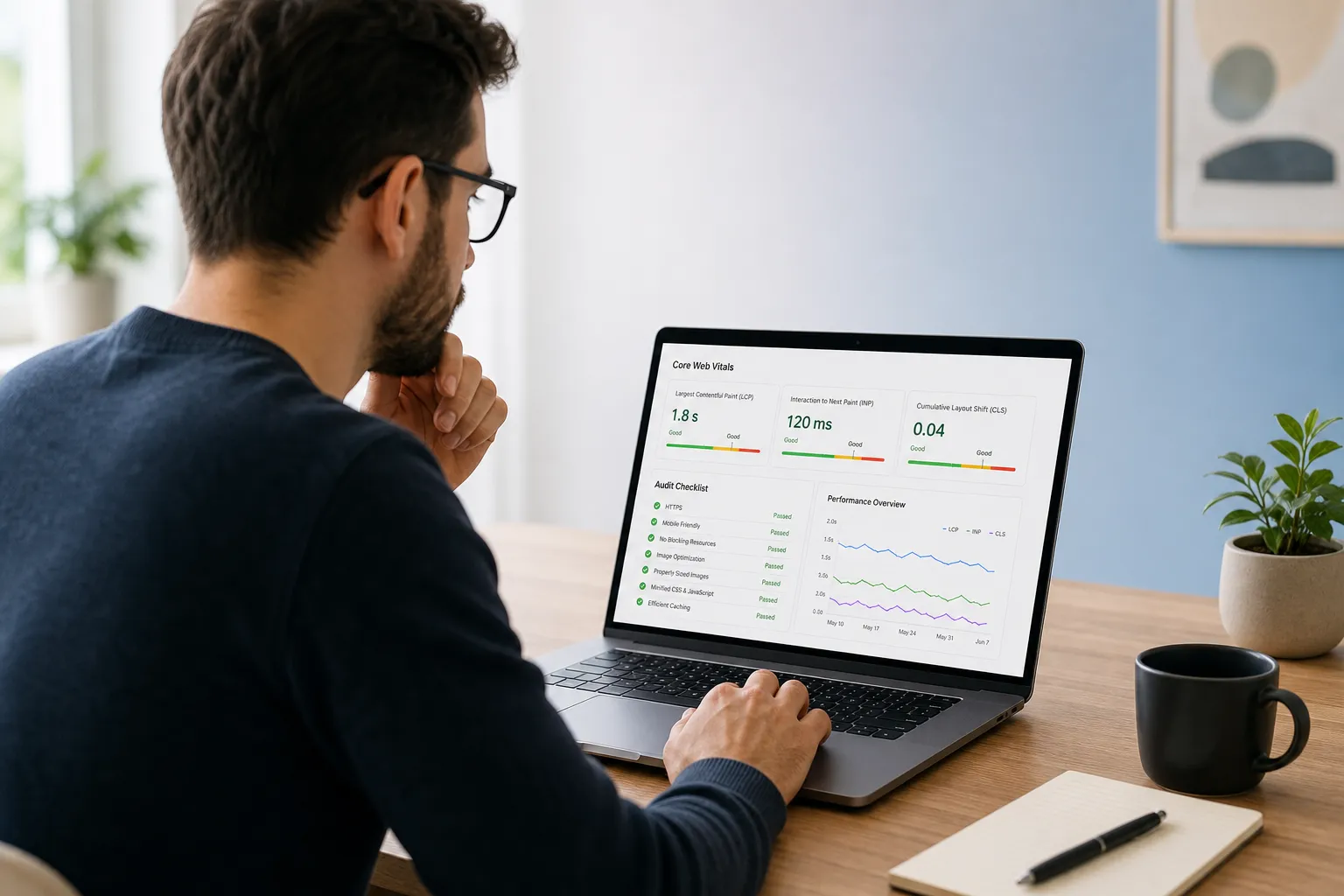
Target the elements that drive LCP, CLS, and INP on money pages first. Aim for LCP under 2.5 s, CLS under 0.1, and INP under 200 ms. Promote the hero image in HTML, inline critical CSS for above-the-fold content, defer nonessential JavaScript, and reserve space for ads, embeds, and iframes. Self-host fonts, subset character sets, and use font-display: swap to avoid invisible text. These moves reduce early friction and lift engagement.
10. Reduce JavaScript bloat and ship critical CSS
Audit scripts and remove what you do not need. Load third-party tags after interaction or on consent. Split bundles so only the code needed for the current route ships. Preconnect to third-party origins you keep. Generate critical CSS for the hero and header, and push the rest asynchronously. Small technical wins compound into faster first paint and more clicks on CTAs.
Fix architecture and platform pitfalls
11. Use clean URLs and canonical tags to avoid duplicates
Keep URLs short, lowercase, and hyphenated. Pick a trailing slash convention and stick to it. Add a canonical tag to the preferred URL for paginated lists, filtered views, and UTM variants so crawlers index the right version. Block internal search results from indexing with a meta robots noindex. Avoid unnecessary parameters that create infinite crawl paths.
12. Tune WordPress settings, themes, and plugins for SEO
Choose a lightweight, accessible theme and limit plugins to what you truly use. Enable XML sitemaps, set media attachment pages to redirect to the file or parent, and prevent thin tag archives from indexing unless you add useful intro copy. Disable emoji and embed scripts if unused, and host fonts locally. Optimize image sizes generated by the theme to avoid shipping 2x assets where not needed. Keep permalinks readable and avoid date-based structures for evergreen pages.
13. Fix ecommerce page and filter pitfalls
Write unique product descriptions that go beyond vendor copy and include use cases, specs, and care instructions. Add Product, Offer, and AggregateRating schema when reviews exist and you meet the guidelines. For category pages, keep only the facets buyers use, allow crawlable filters that change the product set, and canonicalize sorted or trivial parameter views back to the main category. Block internal search from indexing. Add FAQs, comparison blocks, shipping thresholds, and delivery timelines to raise conversion and intent match.
Keep improving with real data
14. Keep content fresh and prune what does not perform
Review pages quarterly for traffic, rankings, conversions, and backlinks. Update top performers with new examples, current screenshots, and the latest data. Consolidate overlapping posts into a single stronger URL and 301 redirect the rest. Remove or noindex content that does not serve a purpose and cannot be improved. A tighter index helps crawlers focus on pages that win.
15. Measure, test, and iterate
In Search Console, filter queries with high impressions and low CTR to find pages that need stronger titles and intros. A/B test titles and above-the-fold copy where your stack allows. Track Core Web Vitals, scroll depth, clicks on key elements, and form starts to see whether changes moved real users. Annotate launches so you can tie shifts to outcomes. Our team pairs technical fixes with copy testing so small changes stack into qualified leads.
On-page SEO is not one setting. It is a sequence of choices that add up to clearer intent, cleaner code, and faster, more persuasive pages. If you want a partner who audits, writes, and ships dev fixes under one roof, our team at Red Studio can turn these tips into revenue-backed improvements.
Key takeaways
- Map each primary keyword to one page and mirror the intent shown in the SERP.
- Craft titles, metas, headings, and internal links that clarify purpose and value.
- Use schema, media optimization, and Core Web Vitals work to lift quality signals.
- Fix architecture issues early so crawlers index the right versions at speed.
- Measure results and iterate. Small technical and copy wins compound into leads.