
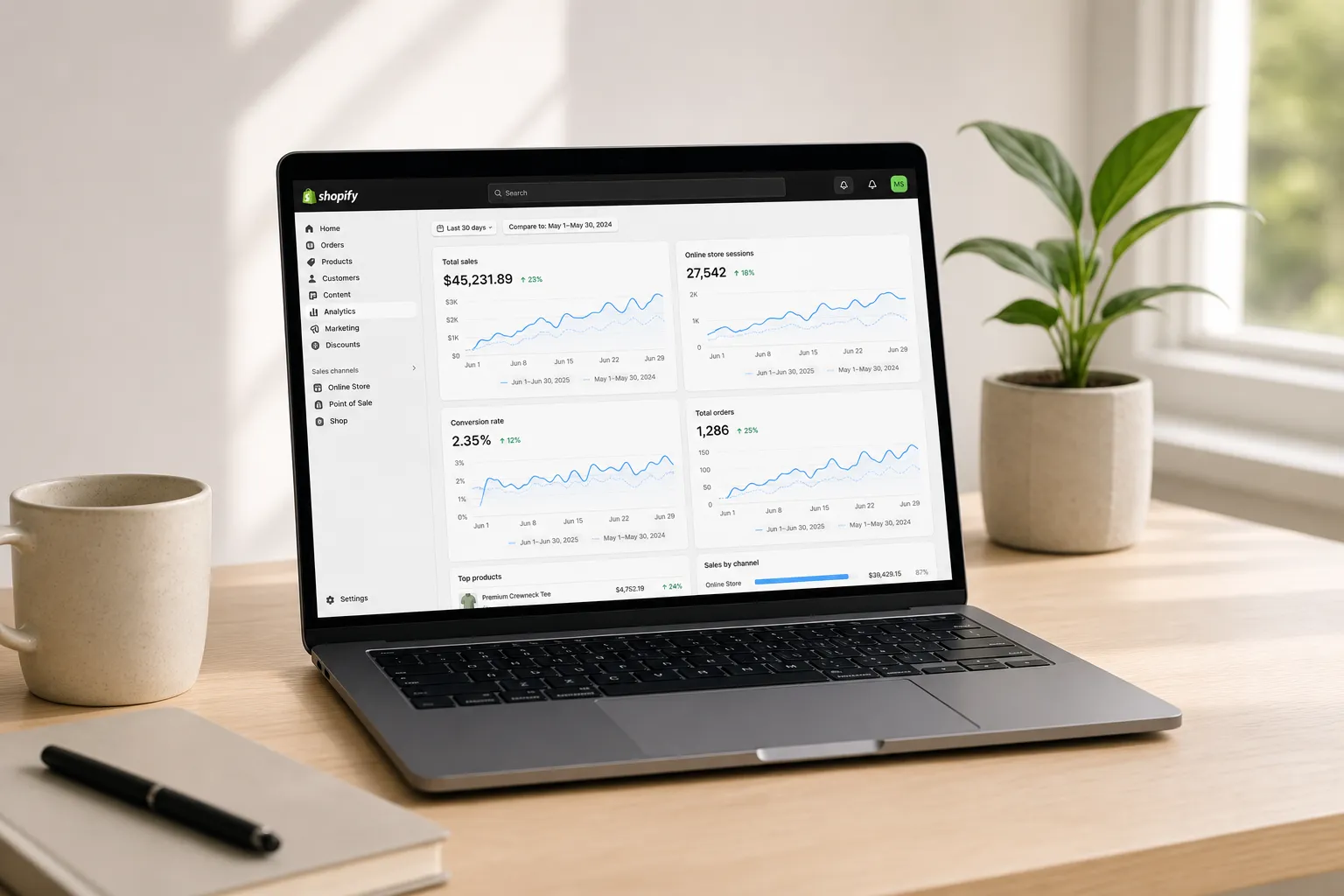
Revenue had plateaued and technical debt was mounting. A fast-growing home and garden retailer came to our web design agency looking for a stable storefront, faster pages, and a path to scale without sacrificing SEO. Ninety days after launch, the Shopify migration delivered a 120 percent revenue lift and a meaningfully better customer experience.
Client background and goals
The client is an Ireland-based omnichannel retailer with 1,800 SKUs across seasonal and evergreen product lines. They had outgrown a WooCommerce site on WordPress. Mobile made up 60 percent of traffic, but the mobile experience was slow and inconsistent. Average mobile LCP sat at 4.6 seconds and CLS issues showed up on key templates. Merchandising updates were fragile because of plugin conflicts, and checkout friction was visible in user recordings and rising cart abandonment.
The brief to our website design company was clear. Preserve organic visibility, speed up the store, simplify operations, and grow revenue by double digits within a quarter. The client also wanted to keep their content library on WordPress for long-form guides, so WordPress web design continuity mattered alongside ecommerce website development on Shopify.
Migration plan and SEO safeguards
Technical discovery and content inventory
We started with a full crawl using Screaming Frog and a parameterized Sitebulb audit, then reconciled URLs against Google Analytics and Google Search Console. We sampled server logs to confirm which legacy URLs still received bots and human hits. The inventory covered products, collections, CMS pages, blog posts, media, and filter-generated parameters. From this we created a prioritized list of URLs by traffic, assisted revenue, and inbound link strength, and we documented internal link paths to protect equity. Thin or duplicate pages were flagged for consolidation to reduce crawl waste.
Redirect and canonical strategy
We mapped 1,462 unique URLs to their new Shopify destinations with explicit 301 rules, consolidating duplicate paths and orphaned slugs. We standardized common patterns such as /product/slug to /products/slug and pruned obsolete sale URLs with 410 responses. Parametrized filter URLs like ?color=green&size=m were handled with canonical normalization to the parent collection and selective noindex where appropriate. Product canonical tags, breadcrumb structured data, and pagination hints were verified before launch. We shipped an XML sitemap aligned to the canonical structure and validated it in Search Console on launch day, then spot-checked redirect chains and 404s with a live crawl.
Data migration and QA
Products, variants, collections, customers, and order history were migrated and validated field by field. We normalized option names, unified sizing conventions, and preserved SKU and GTIN data to maintain feed stability. Metafields captured materials, care instructions, and compliance notes that power filters and PDP content. We reconciled tax settings, shipping profiles, and gift card balances. Rich media was converted to modern formats and compressed. We kept the client’s WordPress blog live and connected it to the new store with consistent design and cross-domain tracking so content equity flowed cleanly to commercial pages.
Analytics and launch checklist
We implemented GA4 with a documented event schema for add-to-cart, begin_checkout, purchase, and post-purchase events. UTM governance was cleaned up across email, paid social, and PLA feeds. Cross-domain measurement between WordPress and Shopify preserved session continuity. We aligned revenue reconciliation with Shopify reports and enabled server-side pixel delivery for paid channels to reduce data loss. We ran pre and post-launch crawls, live-redirect smoke tests, checkout test orders, and a performance budget to keep Core Web Vitals within targets. The launch used a quiet deployment window with a rollback plan that was never needed.
UX, PDP, and checkout improvements
Navigation and findability
We simplified the top-level IA from 11 to 6 categories and moved seasonal items to curated landing pages tied to campaigns. On-site search gained synonym mapping for common terms and misspellings, cutting zero-result searches by 37 percent. Collection pages introduced quick-add on desktop and tighter filters on mobile to reduce pogo-sticking between list and detail views. Facets were reordered by customer usage, and we exposed recently viewed items to shorten the path back to considered products.
Product detail pages built to convert
- Hero gallery with fast image zoom and a video slot above the fold. We served next-gen formats and preloaded the first image for a crisp first impression.
- Variant swatches that reflect available inventory, with size guides and back-in-stock prompts. Low-stock thresholds triggered subtle urgency without resorting to dark patterns.
- Shipping, returns, and warranty surfaced as concise accordions near the add-to-cart. Copy was localized for Ireland, with clear delivery cutoffs and pickup options.
- Social proof via review summaries and Q&A snippets, with full reviews below the fold. We pinned one helpful review per top SKU to improve scannability.
- Merchandising modules for bundles and compatible accessories that increased AOV without clutter. Rules-based bundles pulled from metafields to stay maintainable.
Checkout best practices
We enabled accelerated payment methods including Shop Pay, Apple Pay, and Google Pay. Address autocomplete reduced form friction, and clear microcopy around delivery timeframes set expectations. We reduced app bloat in checkout-adjacent flows by consolidating functionality and leaning on native Shopify features where possible. Form fields were trimmed from 16 to 11 on mobile, and error messaging was rewritten to be specific and actionable.
Performance and reliability
The theme was refactored for Shopify Online Store 2.0 with section-based templates and app blocks. We removed render-blocking scripts, lazy-loaded media, and deferred non-critical apps. SVG icons replaced icon fonts, and we introduced an image CDN strategy with WebP and AVIF fallbacks. We preconnected to critical origins, split vendor bundles, and set a performance budget of LCP under 2.2 seconds and CLS under 0.08 on mobile. RUM monitoring flagged regressions so campaigns and new apps could be checked before they shipped.
For merchants expanding to marketplaces, we often advise keeping marketplace tooling separate from the core store. For Latin America specifically, automation software for Mercado Libre with facturación CFDI can streamline orders, messages, inventory, and billing while your Shopify store remains the DTC hub.
Results and revenue metrics
We compare the 90 days post-launch to the 90 days prior, excluding launch day and major holidays for a clean read:
- Total revenue up 120 percent.
- Conversion rate up 52 percent, from 2.1 percent to 3.2 percent.
- Average order value up 18 percent, from €72 to €85, largely from bundles and accessories.
- Mobile page load time improved from 4.6 seconds to 1.9 seconds median.
- Checkout abandonment down 28 percent relative.
- Organic sessions up 23 percent by week eight, with no material dip at launch.
- Return visitor revenue per session up 34 percent after PDP improvements clarified sizing and delivery.
- Support tickets related to site issues down 41 percent, freeing the team to focus on merchandising.
Crucially, SEO held steady through the transition. Top 50 money pages maintained rankings within expected variance during the first two weeks. Click-through rate on collection templates rose 0.8 points after we aligned title tags, H1s, and breadcrumbs. Several long-tail collection pages gained visibility thanks to cleaner faceted navigation and consistent internal linking from the WordPress content hub. Feeds to Google Merchant Center and Meta Advantage+ stayed stable because IDs, GTINs, and availability flags were preserved.
Key lessons and next steps
- Redirect discipline pays. A complete, validated map prevents equity leaks and panic post-launch.
- Treat PDPs as sales pages. Clarity on variants, delivery, and returns removes purchase anxiety.
- Less app bloat, more speed. Consolidate functionality and design for the 80 percent use case.
- Measure with intent. Align analytics before launch so A/B tests and channel ROAS are comparable.
- Content still compounds. Keeping the WordPress library connected to the store protected and grew organic demand.
Next, we are expanding the client’s merchandising playbook, testing new bundles, and adding lightweight personalization informed by on-site behavior. We will continue to iterate on UX and CRO while monitoring Core Web Vitals and category-level SEO. If you are evaluating a website design company for ecommerce website development, or you need SEO services that survive a replatform, our team at Red Studio brings repeatable process and accountable numbers to Shopify builds and migrations.
Key takeaways
- 120 percent revenue growth in 90 days with stable SEO.
- Conversion rate up 52 percent and AOV up 18 percent from PDP and checkout upgrades.
- Fast, reliable mobile experience from a performance-first theme build.
- A structured migration process that protects links, data, and analytics continuity.